
Hidden Costs of Poor Document Control: The Numbers Will Surprise You
Most executives focus on the big-ticket budget items, like headcount, infrastructure, and software licenses. But there’s a slow, silent drain happening in your organization that rarely shows up on any spreadsheet. Poor document control! It isn’t just an operational annoyance but a genuine financial liability, and the numbers behind it are jarring.
Let’s break down exactly where the money is leaking. Because if you can’t stop it, no matter how well your business is running, everything will fall apart. And you will stand still, wondering, “How did it even happen?”
The Invisible Price of Poor Document Control Your CFO Needs to See
Your Employees Are Wasting Hours Just Searching for Files
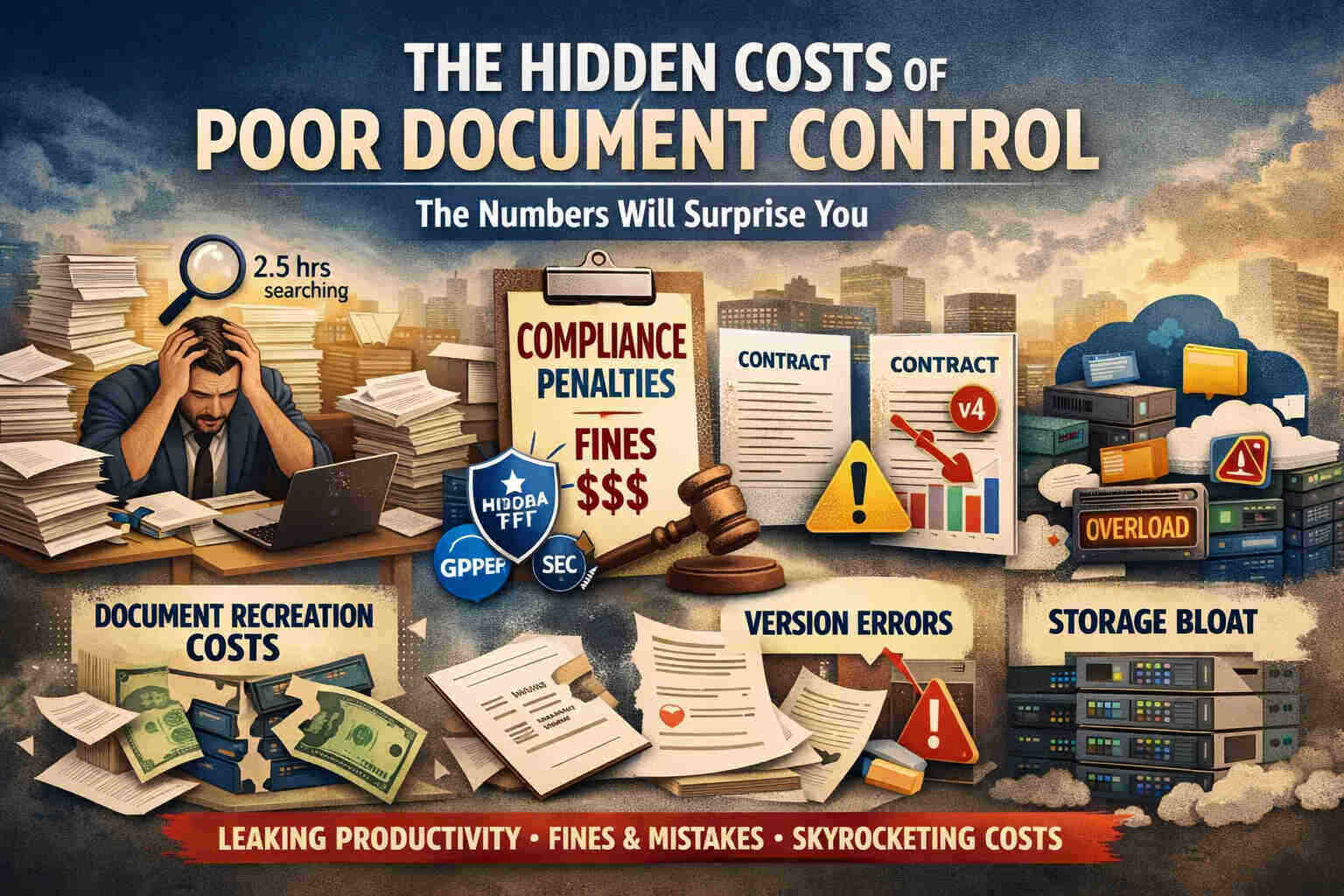
According to research, employees spend an average of 2.5 hours per day searching for documents. That’s nearly a third of the workday — gone. Multiply that across your entire workforce, factor in average salaries, and you’re staring at a six or seven-figure annual loss in pure productivity. And that is just searching. It does not count the time spent recreating documents that already exist but simply can not be found.
Recreating Documents That Already Exist Costs a Fortune
When employees can’t locate a previous contract, report, or proposal, they don’t wait and state rebuilding it from scratch. This duplication of effort is shockingly common in organizations without structured Digital Document Management practices. One study estimated that document recreation alone costs large enterprises thousands of dollars per worker annually. That’s not a rounding error, but a budget line that should scare you.
Compliance Failures Come with a Very Real Price Tag
Poor document control creates dangerous gaps in audit trails and regulatory compliance. In industries like healthcare, finance, and legal services, the consequences are severe:
- HIPAA violations can run from $100 to $50,000 per violation (ranges vary by year)
- GDPR penalties can reach 4% of your global annual revenue
- SEC recordkeeping failures have resulted in fines exceeding $1 billion across firms
If your documents aren’t properly stored, versioned, and accessible, you’re not just disorganized; you’re exposed.
Version Errors Lead to Costly Business Mistakes
Sending a client an outdated contract, submitting a proposal with last quarter’s pricing, approving a project based on a superseded specification- these aren’t hypothetical scenarios. They happen every week in organizations where version control is loose or nonexistent. The downstream costs (like rework, legal disputes, and damaged client relationships) are hard to quantify but very real to your bottom line.
Storage Bloat Is a Hidden IT Cost Nobody Audits
Without proper document lifecycle policies, organizations accumulate years of redundant, obsolete, and trivial files. This bloat quietly inflates cloud storage costs, slows system performance, and creates security risks around sensitive data that should have been archived or deleted long ago. Most IT teams inherit this mess without ever being given the tools to clean it up.
The Right Infrastructure Changes Everything and Can Save Your Business
Organizations that invest in proper Document Management Software consistently report measurable returns, faster retrieval times, fewer compliance incidents, reduced storage overhead, and lower administrative costs. The upfront investment looks very different when you’re comparing it against the true cost of doing nothing.
Final Words
Here’s the hard truth: poor document control rarely triggers a single catastrophic event. It bleeds you slowly. And by the time most organizations notice it, they’ve already paid dearly for it. The question is not whether poor document control is costing you money. It is how much longer you are willing to let it.